Return to All Insights
Technical Analysis: Natural Marble vs. Engineered Quartz in Commercial Environments
Bao Kien Stone Technical Department
Material Science
Specifying surface materials for commercial spaces—such as hotel foyers, office lobbies, and retail centers—requires a rigorous balance between material authenticity and mechanical durability. Natural Marble and Engineered Quartz are two categories frequently evaluated in this context. This article analyzes the microstructures and physical properties of both materials to support the decision-making process of architects, specifiers, and contractors.

1. Microstructure and Surface Porosity
Natural Marble: A metamorphic rock composed primarily of recrystallized carbonate minerals, most commonly calcite or dolomite. The natural geological process creates a micro-capillary network, resulting in a specific degree of porosity. This characteristic mandates that the surface be treated with penetrating sealers periodically to prevent the ingress of moisture, solvents, and biological agents.
Engineered Quartz: Synthesized from approximately 90-93% natural quartz aggregates and 7-10% polymer resins and pigments under a vibro-compression vacuum process. The dense epoxy binder structure completely eliminates micro-pores (non-porous), providing near-absolute impermeability without the requirement for topical or penetrating protective coatings.
2. Mechanical Hardness (Mohs Scale) and Abrasion Resistance
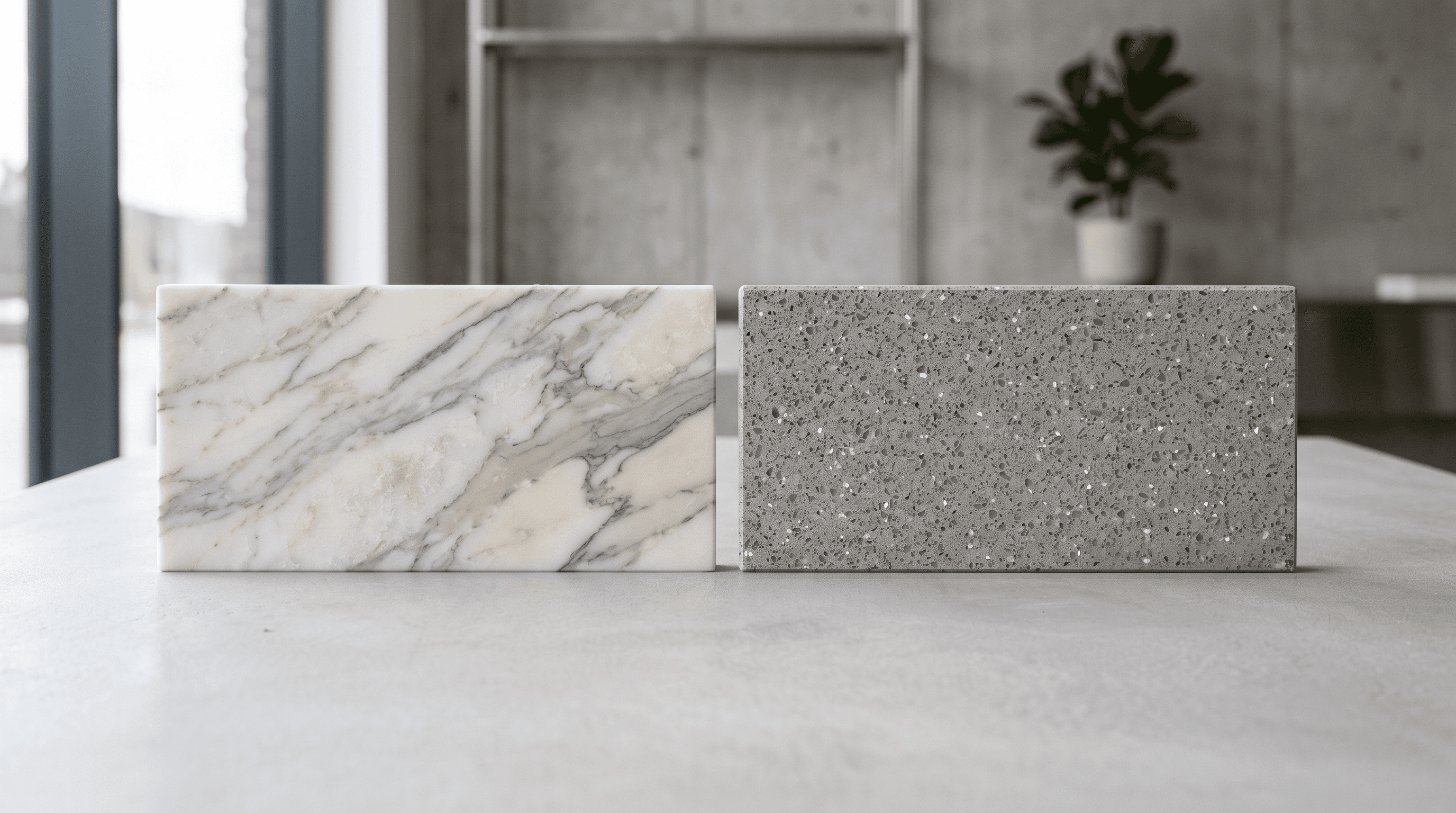
Mohs Scale: Natural Marble typically ranges from 3 to 4 on the Mohs hardness scale, whereas Engineered Quartz achieves a rating of 7.
Practical Application: This significant differential in hardness dictates scratch resistance when the material is subjected to mechanical friction (e.g., particulate matter and sand under footwear in entryway zones). Quartz exhibits superior surface stability in areas with dense, continuous traffic flows. Conversely, Marble will develop micro-abrasions and surface dulling (etching) over prolonged use unless maintained through a strict, specialized repolishing protocol.
3. Chemical Reactivity and Thermal Stress
Chemical Resistance: The calcium carbonate composition of Natural Marble reacts actively with acidic solutions, making it highly susceptible to chemical etching and staining from common commercial spills. Engineered Quartz, utilizing a chemically inert polymer-based binder, demonstrates high resistance to the majority of standard commercial cleaning agents and industrial solvents.
Thermal Resistance: Natural Marble possesses excellent thermal mass and heat dissipation properties, allowing it to withstand high temperatures without structural compromise. In contrast, the polymer resin matrix within Engineered Quartz can experience localized deformation or discoloration (thermal shock) if exposed abruptly to heat sources exceeding 150°C.
Specification Conclusion Material selection is not determined by absolute superiority, but rather by the specific functional and aesthetic requirements of each architectural zone. Natural Marble remains the definitive material for focal feature walls, executive washrooms, or high-end reception desks due to its unique, non-repeating veining (book-matching potential). For heavy-duty operational countertops, food service areas, or high-density circulation floors, Engineered Quartz provides essential technical stability, visual uniformity, and highly optimized lifecycle operational costs.
Share Insight:


